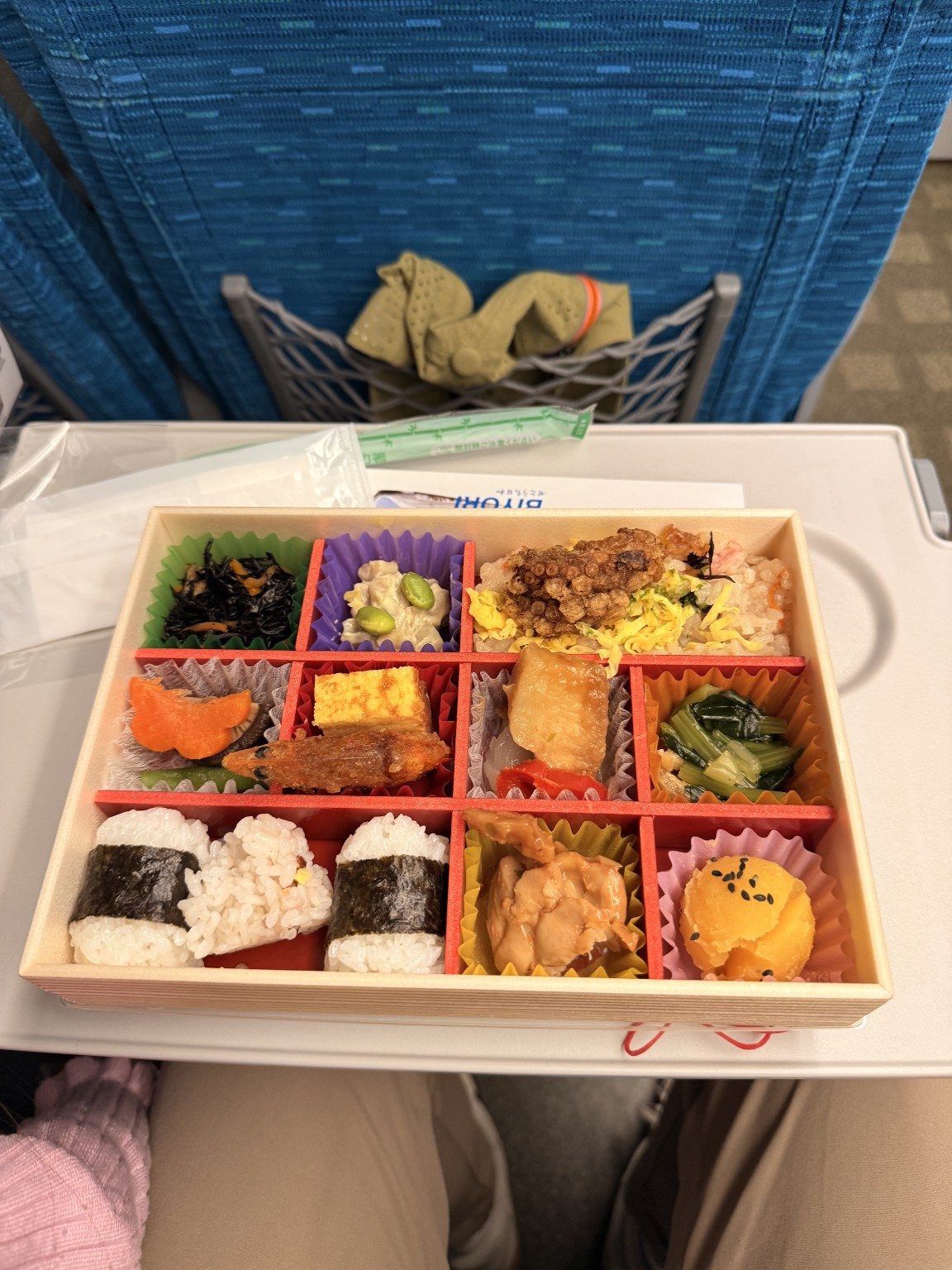
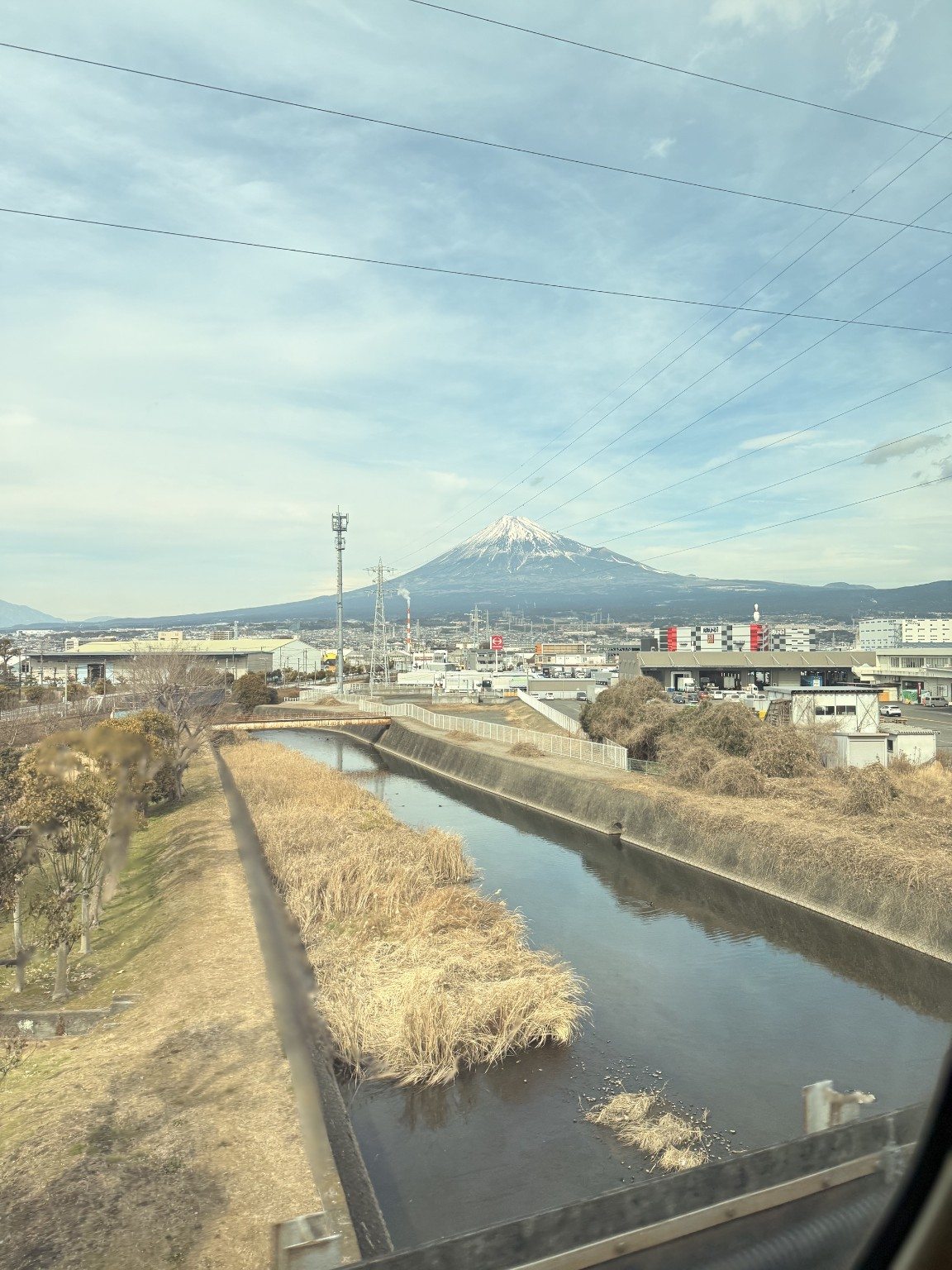
Our train photographs captured two things I would make room for again: a bento on the tray table and Mount Fuji outside the window. The practical part is buying the right ticket and reaching the right platform. Once that is sorted, the journey can be a part of the holiday you enjoy rather than a gap between the cities.
This guide is for the Tokaido Shinkansen between Shin-Osaka and Tokyo or Shinagawa. Osaka Station and Shin-Osaka Station are different places. If you are based around Namba, include the journey to Shin-Osaka in the plan. In Tokyo, choose the arrival station around your onward journey rather than assuming every hotel is near Tokyo Station.
Choose the train before the lunch
Nozomi is generally the quickest option on this corridor. Hikari makes more stops, and Kodama stops more often again. Check the actual departure and arrival times in the booking results rather than choosing by name alone. For planning, think of the ride as roughly two and a half hours on a fast service, then add local travel and station time at both ends.
I would reserve seats together for a family. A non-reserved ticket can be useful in some circumstances, but it is not a promise that you will find adjacent seats. During major peak periods, Nozomi runs with all seats reserved, so check the arrangements for your dates. Those holiday journeys deserve earlier planning.
The transfer day should stay fairly simple. I would not book a timed attraction shortly after the advertised train arrival. You still need to get off, find the local connection and reach the accommodation with your luggage.
How to buy tickets
SmartEX is the official online booking option for this route. Register, enter the stations and travel date, choose the number of passengers and inspect the available trains. Check the seat class and fare conditions before paying. A cheaper restricted product can have different change rules from a standard booking.
Use the seat map when the view or sitting together matters. Select any required oversized-baggage arrangement during booking rather than hoping the space behind the last row is free when you arrive. Save the reservation details and make sure each passenger has the appropriate boarding method assigned.
Station ticket machines and staffed ticket counters are alternatives. Machines have English menus. A counter is useful if you need help with the journey or passenger categories. Allow time for a queue instead of assuming a station purchase will take two minutes.
For a conventional paper purchase, the price includes a basic fare and a Shinkansen limited-express component. They may appear on separate tickets or be combined. An ordinary local-train IC-card balance alone is not a reserved Shinkansen ticket.
What does Osaka to Tokyo cost?
As a starting budget, I would allow about ¥15,000–16,000 per adult each way for an Ordinary reserved seat, then get the actual quote for the chosen date and service. This is a rounded planning allowance, not a fixed fare or the amount on our own ticket. Seasonal adjustments and discounted products can change what is available.
For two adults, that allowance means roughly ¥30,000–32,000 one way, before a child's ticket, local connections and food. Check the child category against the railway's rules and your child's age. If a young child needs their own reserved seat, do not assume that seat is included free simply because they may otherwise travel without a separate seat.
The national Ordinary Japan Rail Pass currently lists ¥50,000 for seven days, with longer options available. One Osaka–Tokyo journey does not come close to that figure. Even a return journey alone is usually a reason to compare individual tickets carefully rather than buy the pass automatically. Nozomi also needs the pass-holder supplementary ticket when used with that pass. Check eligibility and the journeys actually covered before deciding.
For the itineraries on this site, staying in one Osaka area and one Tokyo area means relatively few long-distance transfers. A longer holiday does not automatically make an unlimited rail pass the best value.
The Mount Fuji seats in both directions
The simple rule for the usual Tokaido layout is E for the Ordinary-car window, D for the Green-car window on the mountain side. Check the actual seat map if you choose a different accommodation type.
| Direction | Mountain side facing forward | Usual Ordinary window | Usual Green window |
|---|---|---|---|
| Tokyo or Shinagawa towards Shin-Osaka | Right | E | D |
| Shin-Osaka towards Tokyo or Shinagawa | Left | E | D |
In an Ordinary car, D is the aisle seat beside E. In a Green car, D is the window. That difference is easy to miss if someone only tells you to book “D or E”. A family can choose nearby seats, but only one person gets each window in a row.
The mountain is around the Shin-Fuji area. I would start paying attention before reaching that stretch rather than rely on an exact minute after departure. Different trains have different stopping patterns. Cloud and visibility decide what you see, and a window booking cannot guarantee a clear view.
Our photograph did catch Fuji beyond the river and buildings. That is why I would choose the same mountain side again, while leaving the weather out of the promise.
Luggage deserves a check before booking
Measure large bags by adding their length, width and height. On this corridor, luggage with a combined measurement over 160 cm and up to 250 cm requires the appropriate oversized-baggage arrangement. Bags over the permitted limit cannot simply be brought along because you have bought a seat.
Do not assume every luggage storage facility has identical reservation rules. Follow the current SmartEX baggage guide and select the option it specifies for your bag and train. The area behind the last row is associated with designated seats; it is not spare space for anyone who gets there first.
Even with smaller luggage, think about what you can lift and manage while keeping the aisle clear. A family transfer gets easier when there is less to carry. I would check the storage plan at home rather than negotiate it after boarding.
Using the gates and finding the car
SmartEX supports assigned QR tickets and compatible linked transport IC cards. Follow the instructions for the method you chose. For QR boarding, scan the proper passenger QR at the Shinkansen gate and keep the seat-information slip the gate issues. That slip reminds you where to sit; it does not replace your boarding credential for the exit.
With paper tickets, keep them after passing through the entry gate. If the journey has issued both a basic-fare and express ticket, use the gate instructions for the pair rather than discard one. Staff can help at the manned gate if the combination is unclear, particularly when transferring from a local service.
Read the departure board for the train number and platform. The markings on the platform identify where the cars stop. Queue at your car rather than board wherever you happen to be and try to move the family's bags through the whole train.
I would arrive at the station with a comfortable buffer, longer if buying tickets or food. That is our planning preference, not a railway check-in requirement. The train departs at its scheduled time; the bento shop queue is not a reason for it to wait.
The bento is worth choosing before you board
Ekiben are station bento sold for the journey. Our photographed box had several compartments, with rice and small portions arranged separately. It made a nice record of the train lunch without needing to identify the exact brand afterwards.
At Tokyo Station, Ekibenya Matsuri in GRANSTA Tokyo is one named option to look for, with a wide selection of station bento. Check its position inside the JR gates before making a detour; it is not a claim that our photographed lunch came from that shop.
Look at the station's bento shops before you commit. A mixed box can suit someone who wants variety; another traveller may prefer a simpler chicken or beef-and-rice option. At some shops you may find novelty train-shaped containers, which could be a fun choice for a child. Availability varies, so I would treat a specific box as a bonus rather than promise it in advance.
For budgeting, allow roughly ¥1,000–2,000 per bento as a starting estimate and check the shelf price. Premium boxes can cost more. That range is an allowance, not a quote for the meal in our photograph. Read ingredients and storage instructions, and buy food you actually want to eat rather than choose only for the packaging.
Take drinks aboard too. Ordinary-car onboard food sales are not something to rely on for this route. Eating at the tray table is normal on the Shinkansen, but keep the seat and surrounding area tidy and avoid noisy calls or audio that other passengers have to listen to.
A local commuter train is a different setting. I would save the full bento meal for the intercity ride rather than start it on a crowded connection just because the food is already in the bag.
What I would organise first
Choose the correct stations and departure, book seats together, then sort the luggage arrangement. After that, leave time to buy lunch. Keeping that order makes the food and the view something to enjoy instead of two more things to get right while rushing.
Our four-week Japan journal is here. For a shorter route, start with the one-week plan.